JC Education Materials

Journey Capably (JC) Education Solutions maintains the integrity of all of its materials created on behalf of its clients. As such, all previously created materials have been copyrighted and cannot be shared and is in accordance with provincial, federal, and national copyright laws. Some of our previous clients include, but are not limited to:

  1. Alberta Labour/Calgary Immigrant Educational Society: Curriculum Development Foundations for Agricultural-Based Programs for Refugees and Migrants
  2. APass Education Solutions: Development of Assessment Tools-Questions, Evaluation Criteria & Curation for K-12 and Post-Secondary Programs
  3. Crosspointe Fellowship (Nicaragua): Curriculum Development- Beginner English Language Training
  4. iTutor Group: Development of Lesson Plans-Online Language Platform
  5. Mount Royal University – Continuing Education and Extension: Curriculum Development- Pathways for Internationally Educated Professionals
  6. University of Manitoba- Professional Programs and Extension: Curriculum Development- Facilitation & Instruction Course in PDAL Program
  7. Wings of Hope for Africa: Fund Developer and Writer

To inquire about our services, please submit a formal request including the

  1. Required Service
  2. Preliminary Work (If Any)
  3. Timeline (If Any)
  4. Partners (If Any)

A JC Education Consultant will respond within 3-5 business days with a formal proposal.

ADDIE Model

In order to design effective and thoughtful learning activities, the ADDIE Model is used to  analyze, determine, develop, implement, and evaluate project outcomes and objectives. To enact the ADDIE Model, Journey Capably Education Solutions will:

Analyze: Collaborate with Stakeholders to Answer Key Questions

  • What are we trying to accomplish?
  • What resources do we have?
  • What human resources do we need?
  • What are the course parameters?
  • What are our wish list items (e.g. must haves and would like to have)?
  • What are the pedagogical considerations for online learning and curriculum development (instructional design principles)?

Design: Identify Purpose, Resources, Needs, and Wish List Items

  • Identify materials and human resources
  • Establish a project timeline
  • Develop course learning objectives and outcomes where applicable
  • Review learning outcomes and objectives with key stakeholders
  • Create templates for
    • Course Overview Pages
    • Story board
    • Course map
    • Syllabus
    • Outline
    • Prototype Unit

Develop: Use the Constructivist Approach to Teaching and Learning in Instructional Design

  • Develop assignments to align with course learning outcomes and assess for levels of questioning using Blooms Taxonomy
  • Review assignments to assess for different types of assessments (e.g. peer, student, formative, and summative)
  • Review program requirements
  • Create a scope and sequence of skill building and skill using activities to align with established parameters and competencies
  • Meet with key stakeholders (e.g. coordinator and SMEs) to review and refine objectives, outcomes, activities, and assignments
  • Develop course activities
  • Assess activities for student interaction, engagement, timelines, and feasibility
  • Team meeting to review project alignments (e.g. activities, assignments, etc.)
  • Forward or Create Storyboard in LMS & Design a Piloting Plan

Implement: Create and Enact Pilot Plan

  • Create checklists and expectation matrix for instructor
  • Responsibilities for online team
  • Statement of work
  • Training for instructors (e.g. Instructor Guide)
  • Training for learners (e.g. Orientation/Induction)
  • Select audience and teacher to pilot course

Evaluate: Report on Findings, Gaps, and Recommendations

  • Obtain feedback from instructors and students about experience
  • Offer analysis of program strengths, weaknesses, opportunities and threats
  • Finalize project plan

Florida State University, 1970.

Curating Material

For many instructional designers, content developers, and instructors, locating material for a program, course, or lesson can be a challenge. Where do you find resources? How do you ensure resources are appropriate for your audience? How do you validate the reliability of a resource? How do you evaluate resources? The answers to these questions lay in the curation process, which is 1) identify resources, 2) locate material, and 3) evaluate for open use.
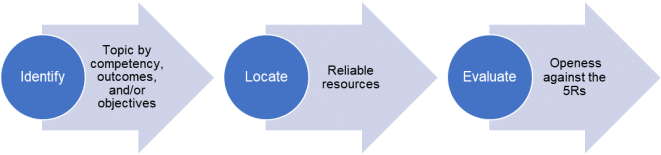
The Curation Process First, before diving into sampling materials, it is wise to identify the desired outcome you are trying to achieve. Is it to impart knowledge? If so, you may require a text based resource (e.g. textbook, discussion, article, etc.). However, if you are looking for a template to achieve an objective then perhaps you may search for classroom activities or material. On the other hand, if you are looking for media to enhance your activities, you may want to search for media based items (e.g. images, music, etc.). Therefore, the first stage of the curation process is to identify the topic of curation. This can be done by identifying or creating outcomes or objectives for the program, course, or lesson.

Next, you want to identify Open Educational Resources (OERs). OERs are resources that have been created by individuals, educational groups or firms, or academic institutions that grant permission to others to use the material for educational purposes. However, each resource has a unique licensing agreement when shared with potential designers, developers, or instructors and is governed by laws in Canada, the USA, and around the globe called Creative Common Licenses (CCL). For example, if you want to use a few chapters from an OER text, there may be a CCL that requires that you cite the source or give credit to the original creator. Other CCLs may indicate that you may use the material, but that it cannot be changed or adapted. The best place to locate OER materials is to search OER repositories or conduct a search on Edu.Google. Click here to see an overview of how to Validating Open Educational Resources. Click here for  a directory of OERs.

The final step in the curation process is the evaluation of materials. This is completed to ensure that we respect the authors who have created materials and that we are free to use the materials in programming, course work, or in classroom activities. To do this, we ask five questions:

  1. Retain: do we have the right to make, own, and control copies of the content?
  2. Reuse: do we have the right to use the content in a wide range of ways (e.g., in a class, in a study group or on a website)?
  3. Revise: do we have the right to adapt, adjust, or alter the content (e.g. translate the content into another language)?
  4. Remix: do we have the right to combine the original or revised content with other open content to create something new?
  5. Redistribute: do we have the right to share copies of the original content or revisions  (e.g., give a copy of the content to a friend)?

Following the curation process is an efficient way to identify materials, validate resources, and evaluate materials for current and future use.

Cognitive Code Learning: Language Teaching

The Cognitive Code Learning approach in language teaching and learning, is based on the idea that students must be able to connect with real world situations in their everyday social and cultural contexts. Learners who identify with course content are able to use previously acquired language skills (first or additional language) and these language skills in new and meaningful contexts. Here are some examples of how Cognitive Code Learning may appear in language acquisition:

1. Learners ask their colleagues about their goals for the course.

2. Learners create a blog to share their experience about their employment experiences as a newcomer to a country.

3. Learners send an email to their instructor or peers requesting help or clarification about an assignment.

4. Learners discuss how an assignment would be developed and submitted in their countries of origins and how the processes differs or is similar to their new country of residence or citizenship.

What ever the task, learners express should be able to express language in various social contexts, forms, and roles to make language acquisition meaningful. As time goes on, learners will naturally work on correcting vocabulary and grammatical structures in writing and speaking because they are able to first comprehend the context of real-life situations, making language learning an immersed experience.

Assessing the Whole Learner

Learners have an array of knowledge, skills, and abilities as well as challenges caused by gaps in education, health, physical and cognitive exceptionalities. Every year,  educators assess the prior learning of students, state the objectives of each course, and deliver meaningful content in innovative and practical ways while maintaining respect for diverse experiences in the classroom.  The death of a loved one, a divorce, problems with addiction, one or more full time jobs, single parenting, or challenges with the English language are just some of the challenges many learners face while enrolled in post-secondary programs, enough to demotivate any learner.

To address these challenges, institutions are electing to assess the whole learner. Wholeness comes from nontraditional experiences to assess learner readiness, skills, and abilities prior to the start of a program, which may be related to time management, whether in the home or at work, previous education and employment experiences, goal setting, and motivation (portfolio based learning and assessment). Student success is directly tied to the learner’s short and long term goals and awareness of challenges. Learners who are provided with the tools for learning and have their prior knowledge, skills, and abilities appropriately assessed are prepared to meet the demands for learning and life.

Whether learners are newcomers to Canada, recent high school graduates, or mature learners hoping to advance their careers or reenter the work force, all learners have the potential to develop their skills, add to their knowledge base, and achieve their goals.