For many instructional designers, content developers, and instructors, locating material for a program, course, or lesson can be a challenge. Where do you find resources? How do you ensure resources are appropriate for your audience? How do you validate the reliability of a resource? How do you evaluate resources? The answers to these questions lay in the curation process, which is 1) identify resources, 2) locate material, and 3) evaluate for open use.
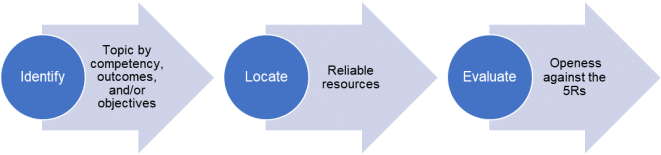 First, before diving into sampling materials, it is wise to identify the desired outcome you are trying to achieve. Is it to impart knowledge? If so, you may require a text based resource (e.g. textbook, discussion, article, etc.). However, if you are looking for a template to achieve an objective then perhaps you may search for classroom activities or material. On the other hand, if you are looking for media to enhance your activities, you may want to search for media based items (e.g. images, music, etc.). Therefore, the first stage of the curation process is to identify the topic of curation. This can be done by identifying or creating outcomes or objectives for the program, course, or lesson.
Next, you want to identify Open Educational Resources (OERs). OERs are resources that have been created by individuals, educational groups or firms, or academic institutions that grant permission to others to use the material for educational purposes. However, each resource has a unique licensing agreement when shared with potential designers, developers, or instructors and is governed by laws in Canada, the USA, and around the globe called Creative Common Licenses (CCL). For example, if you want to use a few chapters from an OER text, there may be a CCL that requires that you cite the source or give credit to the original creator. Other CCLs may indicate that you may use the material, but that it cannot be changed or adapted. The best place to locate OER materials is to search OER repositories or conduct a search on Edu.Google. Click here to see an overview of how to Validating Open Educational Resources. Click here for a directory of OERs.
The final step in the curation process is the evaluation of materials. This is completed to ensure that we respect the authors who have created materials and that we are free to use the materials in programming, course work, or in classroom activities. To do this, we ask five questions:
- Retain: do we have the right to make, own, and control copies of the content?
- Reuse: do we have the right to use the content in a wide range of ways (e.g., in a class, in a study group or on a website)?
- Revise: do we have the right to adapt, adjust, or alter the content (e.g. translate the content into another language)?
- Remix: do we have the right to combine the original or revised content with other open content to create something new?
- Redistribute: do we have the right to share copies of the original content or revisions (e.g., give a copy of the content to a friend)?
Following the curation process is an efficient way to identify materials, validate resources, and evaluate materials for current and future use.
 JC Education Solutions